insum / Product
From a question to an account of the evidence.
insum runs an investigation the way a careful research team would: agree the scope, write the plan, get sign-off, do the work, and hand over findings that can be checked line by line.
Scope
You start with a question in your own words. insum runs a short reconnaissance pass to see what kinds of evidence exist, then proposes research angles.
You decide which angles matter, add your own, and name anything to exclude: jurisdictions, date ranges, source types, or lines of inquiry you have already covered.
- Suggested research angles
- Early signals of where evidence is plentiful or scarce
Plan
insum writes a Research Brief: the question restated precisely, the research questions that will answer it, and acceptance criteria for each, so it is clear in advance what a sufficient answer looks like.
- The Research Brief
- Research questions with acceptance criteria
- The proposed depth of investigation
Approve
Nothing is researched until you authorize it. You can reorder priorities, rewrite or remove questions, tighten exclusions, and choose how deep the investigation should go.
- Priorities and question wording
- Exclusions
- Depth of investigation
Investigate
Parallel workers search for sources, extract claims, verify each one against its passage, find disagreements, and go back for more evidence where coverage is thin.
You can pause, resume, expand scope or finish early. You can also steer the work in progress, for example by adding a question, without necessarily starting over.
- Pause and resume
- Expand scope or steer
- Finish early with what has been verified so far
Inspect
You receive the Research Report and the Evidence Atlas. The report is the synthesis; the Atlas is where you test it.
- Research Report
- Evidence Atlas
- A record of sources that could not be reached
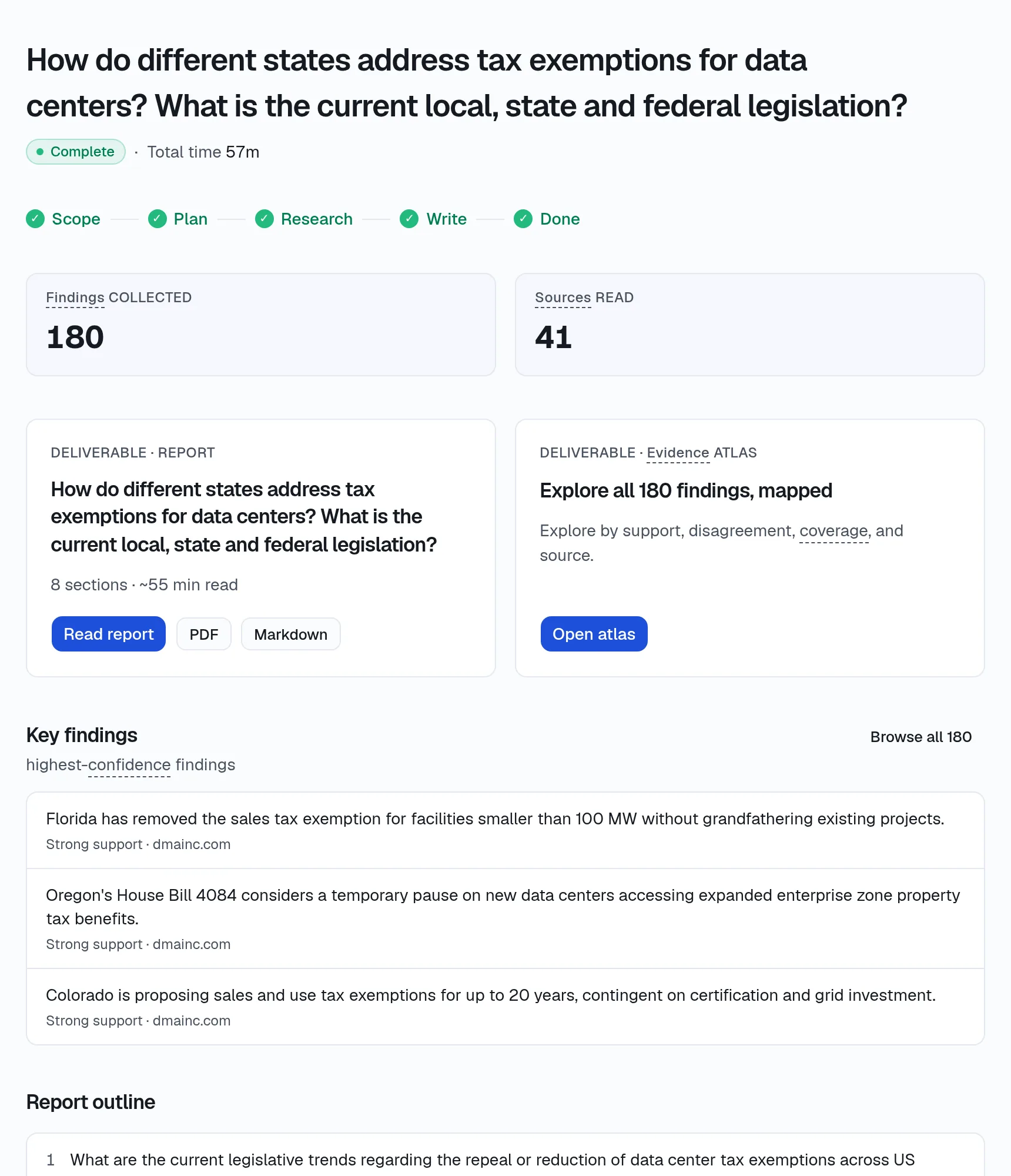
The finished report
Five parts, each traceable.
The report is written for reading, with the apparatus a careful reader needs close at hand.
Executive summary
The answer in brief, with its main qualifications stated up front.
Thematic analysis
The evidence organized by theme, including where themes disagree.
Research questions
A direct answer to each approved question, with how well it is supported.
Bibliography
Every source cited, with type and retrieval details.
Claim-to-source ledger
Each claim, the passages behind it, and its verification status.