insum / Evidence Atlas
Every claim, open to inspection.
The Evidence Atlas is the working companion to every report. It holds all the verified evidence the investigation gathered, including findings that did not make it into the prose, and lets you examine it from seven angles.
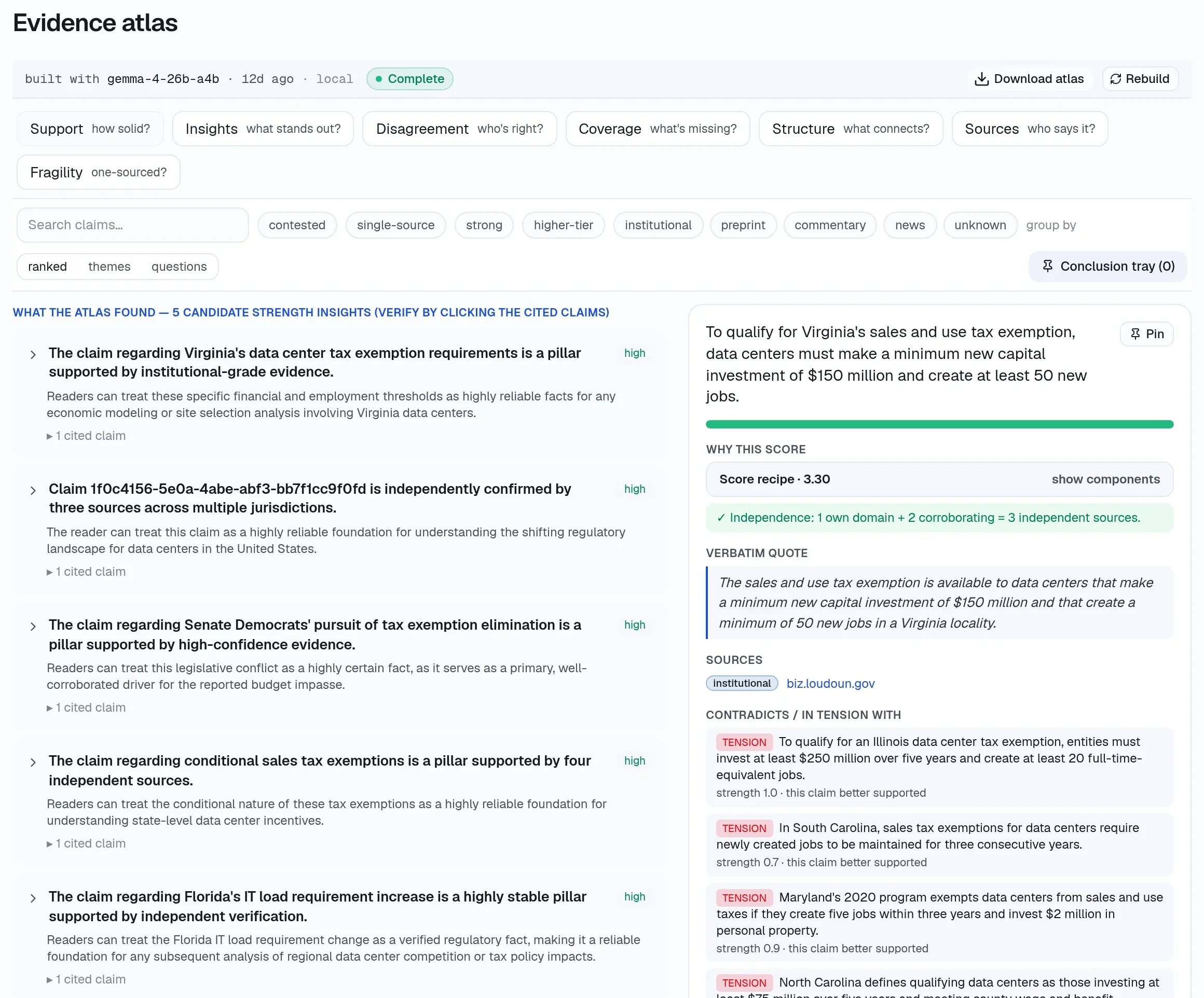
Select a view in the screenshot to switch lenses. Strength scores rank claims within one investigation; they are not probabilities that a claim is true. Screenshots are from a completed insum run used as a placeholder.
The seven views
What each view is for.
Each view answers a different question a reviewer would ask of a piece of research.
Support
Which findings have the most evidence behind them, and which the least? Claims ranked by a support heuristic, filterable by band.
Insights
What patterns stand out? Corroborations, tensions, load-bearing claims, thin coverage and source concentration, collected in one place.
Disagreement
Where does the evidence conflict? Opposing claims side by side, with the sources for each and an explanation of the difference where one is grounded.
Coverage
Which research questions are well supported, thin, or one-sided? Source counts, domains and source-type mix per question.
Structure
How do themes relate? A matrix of theme pairs showing engagement, corroboration, conflict or separation.
Sources
Where did the evidence come from? Every source with its type, provenance, contribution and whether the report cites it.
Fragility
What could break? Single-source claims, claims with thin quotation support, and claims near a band boundary.
Reading the Atlas carefully
What the numbers mean, and what they don't.
Strength is a composite heuristic. It combines the type of source, the number of independent sources, corroboration, how much quoted support was captured, and a penalty for contradiction. It is useful for ranking claims within one investigation. It is not a probability that a claim is true, and it is not comparable across investigations.
Verification means fidelity to the source. A verified claim accurately represents the passage it cites. Whether that source is right about the world is a separate question, which the Atlas helps you judge by showing who said it and who disagrees.
Relationships can be machine-proposed. Some links between claims are proposed by models and are labelled as unadjudicated signals until reviewed.