Research for consequential questions

Research that shows its work.

insum investigates complex questions, builds a structured account of the evidence, and gives you the tools to examine the sources, disagreements, and limitations behind every conclusion.

About insum

Comprehensive research. Evidence you can examine.

insum is an AI research platform built for complex questions that demand more than a quick answer.

Define the scope, direct the investigation, and explore findings drawn from scholarly literature, public records, specialist databases, and the open web. insum synthesizes the evidence into comprehensive research reports, with a rigorous verification process that checks claims against their original sources.

Every report comes with an interactive Evidence Atlas. Examine supporting quotations, compare conflicting findings, uncover research gaps, and understand the strength and limitations of the underlying evidence.

Go beyond the answer. Explore the evidence.

What you receive

Two outputs. One accountable investigation.

Every investigation ends in a written report and an interactive companion built from the same verified evidence.

Output 1

Research Report

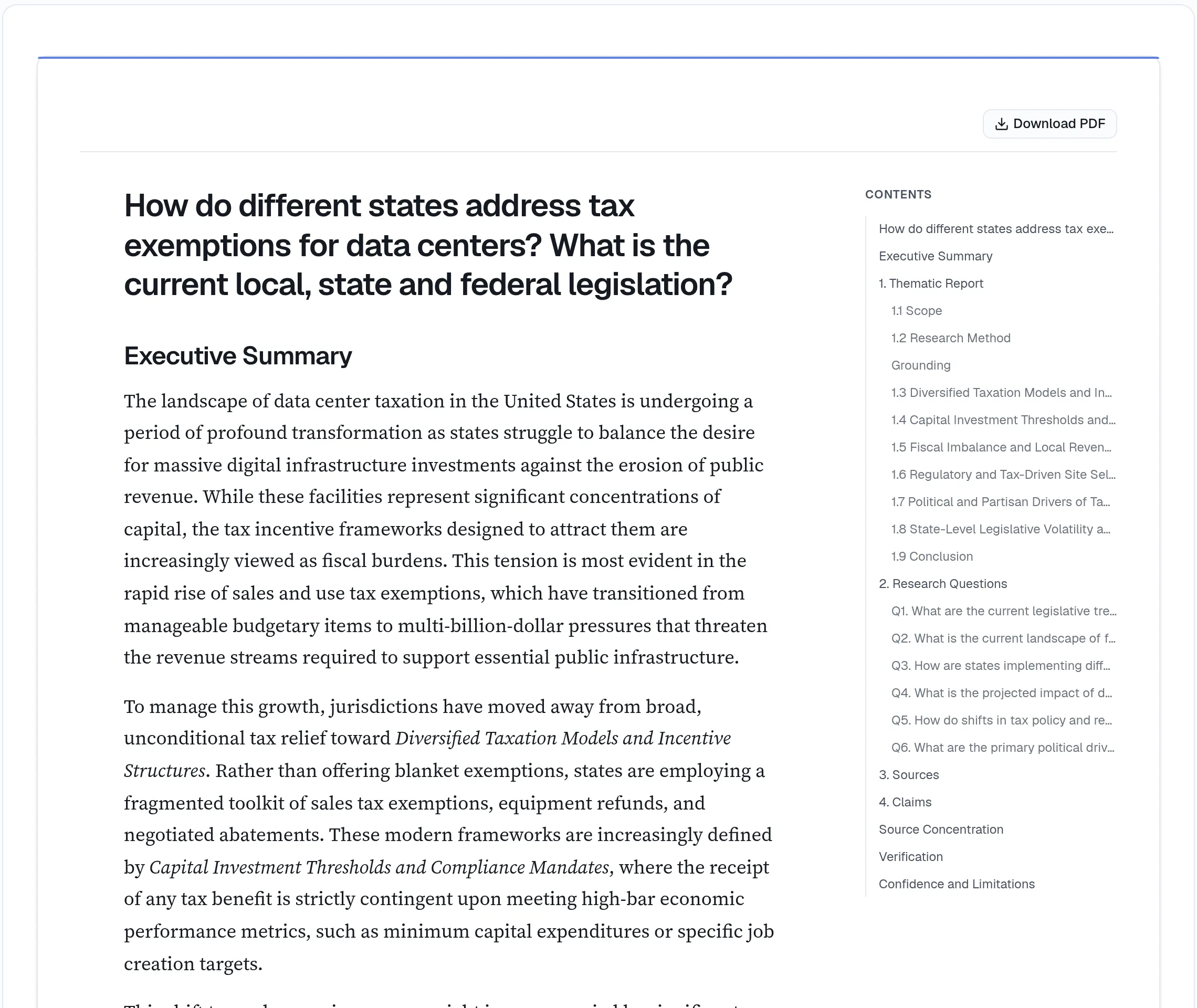
A structured synthesis of what the investigation found, including an executive summary, thematic analysis, answers to individual research questions, a bibliography, and a claim-to-source ledger.

Research Report
A full insum Research Report page with the executive summary and a contents list: thematic report sections 1.1 to 1.9, research questions Q1 to Q6, sources, claims, source concentration, verification, and confidence and limitations.
Output 2

Evidence Atlas

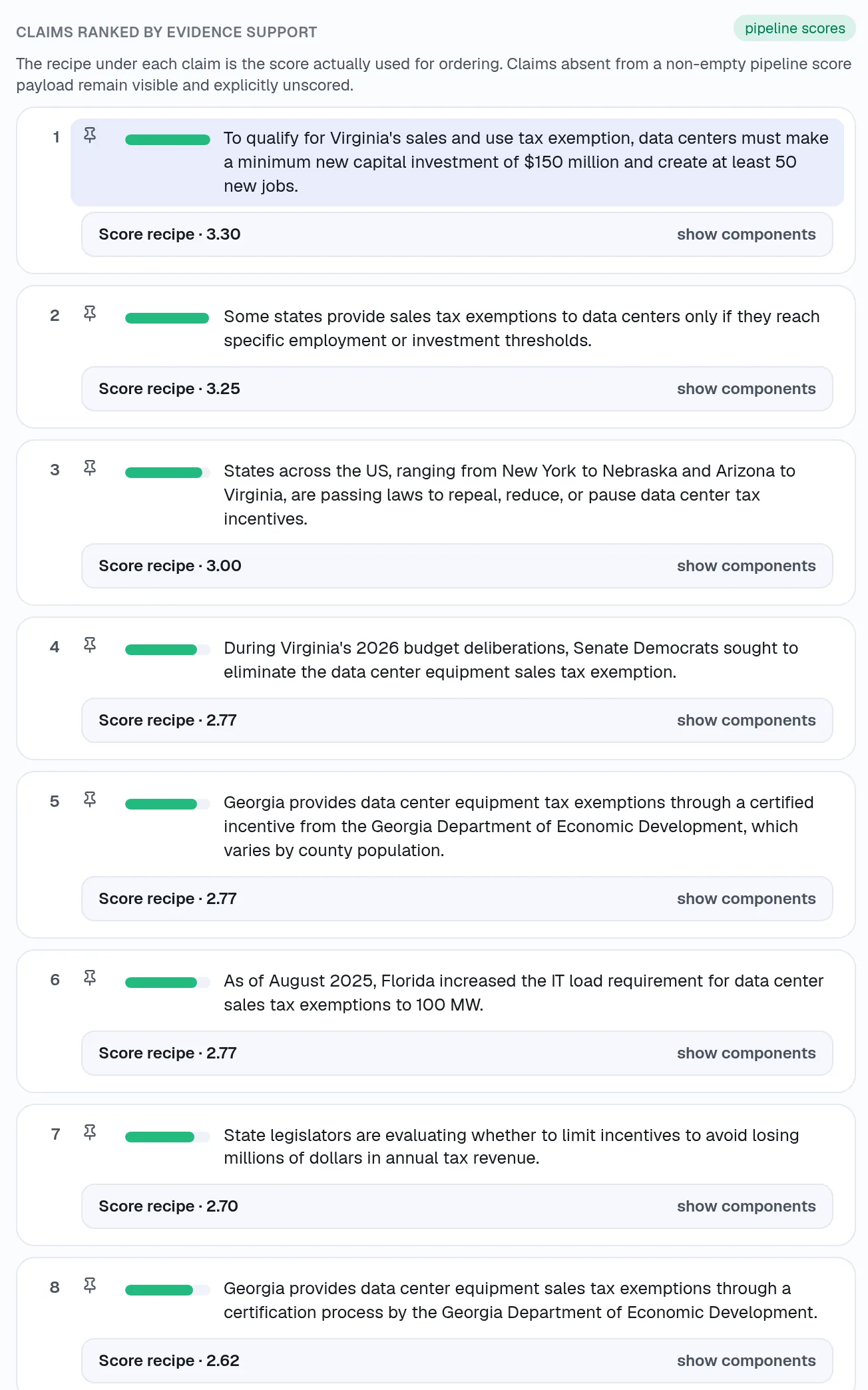
An interactive companion for exploring the evidence behind, and sometimes beyond, the written report. Inspect supporting quotations, conflicting findings, source concentration, research coverage, and areas where conclusions remain fragile.

Evidence Atlas · Claims ranked by support
The Evidence Atlas Support view: claims ranked by evidence support, each with a strength bar and its score recipe, from 3.30 down.

The workflow

You direct the investigation. insum does the research.

Nothing is researched until you approve the plan, and you can change direction while the work is under way.

  1. 01

    Scope

    insum + you

    insum performs preliminary reconnaissance and suggests research angles. You specify what matters and what to exclude.

  2. 02

    Plan

    insum

    insum develops a Research Brief and a detailed investigation plan, with research questions and acceptance criteria.

  3. 03

    Approve

    You

    You revise priorities, questions, exclusions, and depth before authorizing research.

  4. 04

    Investigate

    insum

    Parallel workers discover sources, extract and verify claims, identify disagreements, and pursue gaps in coverage.

  5. 05

    Inspect

    You

    You receive a structured report and Evidence Atlas. Research can also be steered during execution without necessarily restarting.

Why it matters

An answer is only as useful as the evidence behind it.

AI can produce persuasive research without reliably distinguishing established facts, weak evidence, conflicting findings, and unsupported assertions. insum is designed around that distinction. It discovers evidence, verifies extracted claims against their sources, identifies conflicts, and gives you direct access to the material behind its reports.

Corroborated

Supported by several independent sources

Shown with every quote that supports it, and how many sources stand behind it.

Single-source

Resting on one source

Flagged wherever it appears, so a conclusion is never stronger than its evidence.

Contested

Contradicted by other evidence

Both sides are kept, set side by side, with the sources for each.

Unsupported

Not supported by its source

Held or rejected before the report is written, and recorded rather than silently dropped.

Evidence Atlas

View the research. Draw your own conclusions.

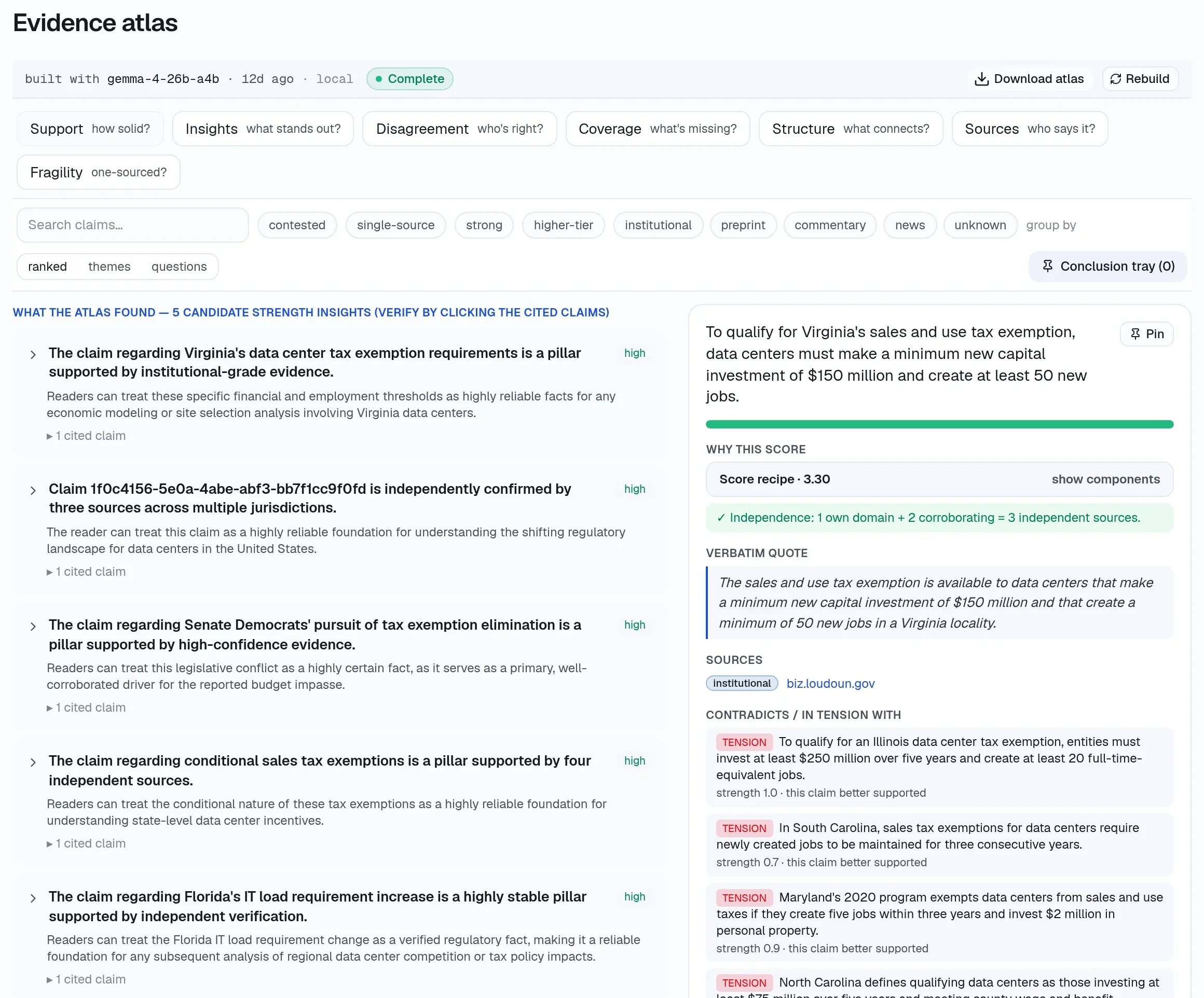
Seven views of the same evidence, each answering a different question a careful reviewer would ask. Choose a view to see it in the product.

How do different states address tax exemptions for data centers? What is the current local, state and federal legislation?

Evidence Atlas Support view from a completed insum investigation. Examine stronger and weaker evidence. Claims are ranked by a support score; open one to see the full recipe.
Note

Select a view in the screenshot to switch lenses. Strength scores rank claims within one investigation; they are not probabilities that a claim is true.

Inside a claim · the panel on the right of every view

  1. The claim

    Stated exactly as it was extracted and verified.

  2. Why this score

    The full recipe behind its ranking: source type, independent sources, corroboration and any conflict penalty. A ranking aid, not a probability that the claim is true.

  3. Verbatim quote and source

    The passage the claim rests on, word for word, with its source and source type.

  4. Contradicts or in tension with

    Findings that pull the other way, each with its own support, so disagreement stays visible.

  5. Corroborated or extended by

    Related findings that support it or add context.

Under the hood

Verification is a process, not a promise.

Four connected stages turn a question into evidence you can check. Each one records what it did, so the result can be audited.

Stage A

Discover broadly

Combine a reusable source library, live web search, and specialist scholarly, legal, governmental, medical, and scientific repositories.

  • robots.txt and site terms respected
  • blocked sources named in the report
Stage B

Verify claims

Confirm source quotations exist, use semantic verification to assess whether they support claims, and hold or reject unsupported records.

  • exact-quote check against captured text
  • semantic support check
Stage C

Reconcile evidence

Build relationships between claims to identify corroboration, contradiction, tension, dependencies, and context.

  • claim-to-claim relationship graph
  • disagreements kept, not averaged
Stage D

Audit the report

Check completed prose against cited evidence, including numerical assertions and unsupported statements.

  • numbers matched to cited passages
  • unsupported sentences flagged

Methodology

Specialized models

Open-weight language models handle planning, extraction, verification and writing. Smaller models trained for a single task work alongside them, such as a classifier that quickly accepts clearly supported claims when the source library is mined.

Versioned source storage

Pages are stored as captured, with retrieval time and location. A quotation can always be checked against the exact version the system read, even if the live page later changes.

Evaluation

Grounding and precision measure whether each statement is supported by its cited passage, without addition. Completeness and correctness measure coverage against a reference and are reported separately, never as a measure of truth.

Built for consequential research

Where the evidence matters most.

For work where a conclusion has to survive scrutiny from a colleague, a client, a reviewer or a court.

01

Legal and Regulatory

Fact-intensive investigations, complex regulatory questions, and research requiring detailed source examination.

From a completed runHow do different states address tax exemptions for data centers? What is the current local, state and federal legislation?

02

Scientific and Medical Research

Synthesizing literature, studies, datasets, and conflicting scientific findings.

Example questionWhat do trials report about long-term outcomes of a treatment, and where do they disagree?

03

Academic Research

Exploring unfamiliar fields, identifying research directions, developing literature syntheses, and examining contradictory evidence.

Example questionWhich open questions in a field are under-studied, and what evidence would settle them?

04

Corporate and Strategic Research

Investigating industries, technical questions, market developments, and competing claims.

Example questionWhich competing claims about a technology's readiness are backed by primary evidence?

insum supports professional research. It does not replace legal, medical or other professional judgment, and its reports are a starting point for that judgment.

Deployment and privacy

Research on your terms.

insum uses open-source models and supports deployment on customer-controlled infrastructure. With sufficient computing capacity and locally available data, organizations can run the research stack without sending sensitive research material to external inference providers.

Option 1

Hosted by insum

The quickest start. insum operates the research stack on infrastructure it controls.

Models run
On insum-operated hardware
Your material
Processed by insum's stack
Discovery
Source library, live web search and specialist repositories
You manage
Nothing to install
Option 2

Customer-controlled

The full stack, including models, runs on infrastructure you own or control.

Models run
On your hardware, with open-weight models
Your material
Stays inside your environment; no external inference provider
Discovery
Your own document collections, plus live web search if you allow outbound access
You provide
Sufficient GPU capacity and the data you want searched

Live source discovery requires network access to the sites being searched, so a deployment that uses it is not offline. A deployment limited to locally available data can run without external connections.

The answer is just the beginning.

See how insum turns complex questions into structured research, and gives you the evidence to examine its conclusions.

Request a Demo or write to contact@insum.ai

Request a Demo

See insum on a question you care about.

Email us with a line about your field and the kind of questions you research. We'll arrange a walkthrough of a report and its Evidence Atlas.

If your email app doesn't open, copy the address above.